
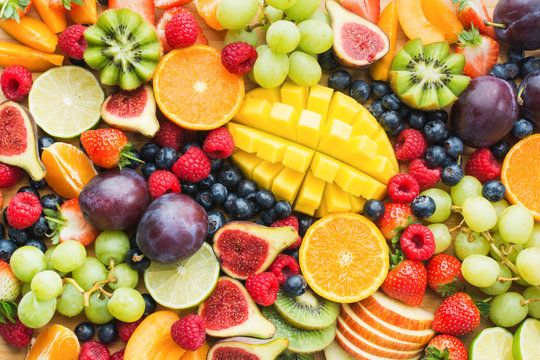
California supplies nearly half of the vegetables and more than three-quarters of the fruits and nuts eaten in the United States.
Perfluoroalkyl and polyfluoroalkyl substances, or PFAS, are called “forever chemicals” because their strong carbon to fluoride molecular bonds can take years to decades — even centuries— to completely break down in the environment. It’s estimated there are nearly 15,000 types of fluorinated chemicals, or PFAS, in existence today.
“The PFAS pesticide is the active ingredient in these products because it’s effective at killing things — which is the very reason why it’s so concerning to public health and the environment at large,” said Bernadette Del Chiaro, senior vice president for California operations for the Environmental Working Group, or EWG, a health advocacy organization that produced the report published Wednesday.
“Unfortunately, there’s no way to contain the harm,” Del Chiaro said. “We can’t just harm the mold spores or insects on a peach and not potentially harm the little kid that eats the peach. The fact that we’re intentionally spraying forever chemicals on the produce we’re buying at the grocery store is a real eye-opener.”
Manufactured since the 1940s to make products nonstick, stain-resistant and water-repellent, legacy PFAS have been linked to cancer, obesity, thyroid disease, high cholesterol, decreased fertility, liver damage, hormone disruption and damage to the immune system, according to the US Environmental Protection Agency. Several of these chemicals can cause harm at levels of a billionth of a gram.
Newer PFAS pesticides also show worrisome impacts on human cells and animal reproductive and nervous systems, although levels of exposure are hard to determine. For example, fludioxonil, which is added to produce after harvest to stop mold and mildew, has killed human cells and damaged DNA in laboratory tests.
“Because there’s not going to be any rain to wash that PFAS pesticide off, it does get a little worrisome,” said Nathan Donley, the environmental health science director for the Center for Biological Diversity, an advocacy nonprofit dedicated to preserving endangered species based in Tucson, Arizona.
“Thes are the foods that actually give us nutrition and what we feed our children, so this is the last place you’d want to see that type of contamination,” said Donley, who was not involved in the EWG analysis. “And I think most people don’t have a clue this is happening.”
The EWG report found the highest levels of fludioxonil on lemons, at over 1 part per million, followed by peaches, nectarines, pears, plums, blueberries and apricots. In addition, fludioxonil was found on 90% of the tested samples of nectarines, peaches and plums.
“The European Food Safety Authority also considers fludioxonil to be an endocrine-disrupting chemical that has harmed the reproductive system in animals,” said report coauthor Varun Subramaniam, a science analyst at EWG.
In response, the EPA told CNN in an email that “EPA evaluates every new and existing pesticide with gold-standard science to ensure the products on the market keep Americans and our food supply safe and healthy with no unreasonable risk of harm. Fungicides, like Fludioxonil, keep America’s food supply safe, abundant, and affordable.”
Despite health and environmental concerns, the use of PFAS pesticides in the United States has been growing over the last few decades, Donley said.
“The new generation of pesticides are PFAS, and it’s genuinely frightening,” he said. “At a time when most industries are transitioning away from PFAS, the pesticide industry is doubling down. We’re definitely moving in the wrong direction.”
CropLife America, which represents the pesticide industry, told CNN in an email that some pesticides are “purposefully fluorinated” to achieve improved durability, resistance to heat and water, better adherence to leaf surfaces, and stronger protection against pests.
“All pesticides, regardless of chemical composition, are subject to the same rigorous scientific review and data requirements under the Federal Insecticide, Fungicide, and Rodenticide Act, the Federal Food, Drug, and Cosmetic Act, and EPA’s implementing regulations and policies,” the statement said.
Combinations of PFAS chemicals
Using 2023 testing data gathered by the California Department of Pesticide Regulation, the EWG analysis found 17 different PFAS pesticides on 40 of 78 different types of nonorganic fruits and vegetables. All told, 37% of 930 samples contained chemicals of concern, the report said.
Bifenthrin, which attacks an insect’s nervous system and is considered a possible human carcinogen, was found on strawberries, blueberries, blackberries, collards, celery, bok choy and green beans, according to the report. Penthiopyrad, which stops fungal respiration and is toxic to aquatic life, was found on strawberries, peaches, plums, green beans, celery, carrots and bell peppers. Lambda-cyhalothrin, which starves insects and is lethal to honeybees, was found on cherries, nectarines, peaches, plums, lettuce and broccoli.
Finding multiple forever chemicals on each type of produce was common, according to the testing. Strawberries, for example, were contaminated with 10 different PFAS pesticides. Cherries and peaches contained seven differen chemicals, grapes, celery and collards six, and spinach had five.
Subramaniam, “Pestisitler ve PFAS hakkında bildiğimiz şey, toplamın genellikle parçalarından daha büyük olduğudur,” dedi. “Bir pestisit karışımına maruz kalmak, her birine aynı miktarda ayrı ayrı maruz kalmaktan genellikle çok daha tehlikelidir.”
Donley’nin gidişatına göre, ABD Çevre Ajansı, pestisitleri değerlendirirken daha fazla ürün elde etme potansiyeli faydalarını olası sağlık zararlarıyla karşılaştırıyor ve genellikle pestisit maruziyetinin seviyesinde oldukça düşük düzeyde karar veriyor.
Source: CNN